When Devices Meet the Cloud — Managing Data Beyond the Edge
Connectivity Is Only the Beginning
In the previous article, we looked at how devices communicate with the outside world. Once connectivity is in place and data can move from the device to a remote system, it can feel as if the hardest part is solved. Measurements are transmitted, dashboards appear, and suddenly the system looks “connected.”
But in reality, connectivity is only the beginning of the data journey.
Moving bytes across a network is technically challenging, but managing the information that arrives on the other side is often the more complex task. Data needs to be stored, organized, secured, and eventually turned into something meaningful. Without careful design, cloud systems quickly grow into something that is difficult to scale, expensive to operate, and hard to maintain.
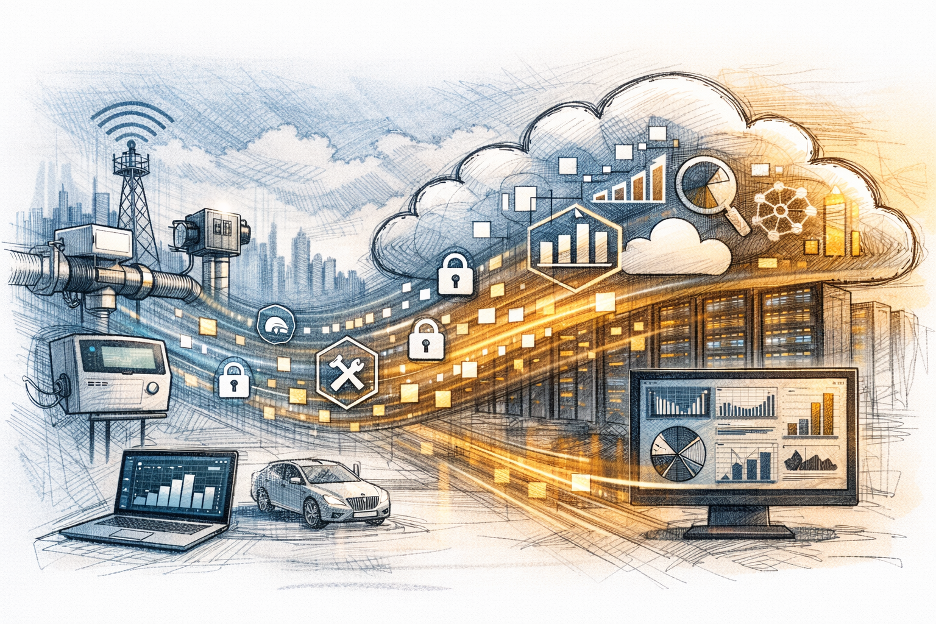
The cloud should therefore not be viewed as the final destination for data. Instead, it is an extension of the system itself — a place where devices can be managed, data can accumulate over time, and insights can emerge from information that individual devices alone could never fully interpret.
Designing this part of the system requires just as much thought as designing the hardware and firmware inside the device.
Designing the Structure of Data
One of the first challenges in cloud integration is deciding how incoming data should be structured and stored.
Embedded devices often produce data continuously, sometimes for many years. Even modest sampling rates quickly grow into enormous datasets once systems scale beyond a handful of devices. A fleet of thousands of units reporting every few seconds can generate millions of data points each day.
If this data arrives without clear structure, it becomes increasingly difficult to work with. Engineers may initially focus on simply receiving and storing measurements, but over time the lack of structure starts to limit what can be done with the information.
A sustainable system therefore needs a well-defined data model from the beginning. Measurements must be accompanied by timestamps and contextual information that explain where the data came from, which device produced it, and under what conditions it was recorded. Just as importantly, the system must be able to evolve. Devices will change over time, firmware will be updated, and new sensors may appear in future hardware revisions.
Designing the data structure with this evolution in mind prevents systems from becoming trapped by their own history.
Managing Devices at Scale
While data often receives the most attention, cloud integration is just as much about managing devices themselves.
Once hardware is deployed in the field, it becomes part of a distributed system that may span factories, buildings, vehicles, or entire geographical regions. Physical access to these devices is often limited, and sometimes impossible. The cloud therefore becomes the operational center from which the entire fleet is monitored and controlled.
This is where device identity, configuration management, and diagnostics become essential. Each device must be uniquely identifiable and able to authenticate itself to the system. Configuration settings may need to change as operating conditions evolve, and engineers must be able to observe how devices behave in real-world environments.
Perhaps the most critical capability is the ability to update devices remotely. Over-the-air firmware updates allow systems to improve over time, fixing bugs, addressing security vulnerabilities, or introducing new functionality long after the hardware has been installed. But this capability must be designed with great care. A failed update process can disable devices in the field, making recovery difficult or impossible.
Reliable update mechanisms therefore rely on careful coordination between device firmware, communication protocols, and cloud infrastructure. The entire chain must work together to ensure that updates are delivered safely and that devices can recover if something goes wrong.
Security as a System Property
The moment devices connect to cloud infrastructure, security becomes a fundamental requirement rather than an optional feature.
Connected systems must ensure that only trusted devices can communicate with the platform and that the data exchanged between them cannot be intercepted or manipulated. At the same time, access to stored information must be carefully controlled, especially in systems that collect sensitive operational data.
Achieving this level of trust requires security to be integrated throughout the architecture. Devices must be securely provisioned during manufacturing so they can prove their identity when they connect to the cloud. Communication channels must be encrypted to protect data in transit, and the backend systems must ensure that devices are only allowed to perform the actions they are authorized to perform.
Security, in this sense, is not a single mechanism but a property that emerges from the design of the entire system.
Turning Data Into Insight
When data flows reliably from devices into a structured cloud environment, its real value begins to appear.
Individual embedded devices are typically designed to perform a specific task within tight constraints on power, memory, and processing capability. The cloud, on the other hand, provides a virtually unlimited environment for storing and analyzing information.
By aggregating data from many devices over long periods of time, it becomes possible to observe patterns that would otherwise remain invisible. Operational trends can be identified, equipment behavior can be compared across installations, and predictive models can begin to anticipate failures before they occur.
However, these possibilities depend entirely on the quality of the data pipeline that feeds them. Poorly structured or inconsistent data quickly becomes an obstacle rather than an asset. In many cases, the success of data analytics initiatives is determined not by the algorithms themselves, but by the quality and reliability of the data infrastructure built long before the first analysis takes place.
The Cloud Is Just Another Part of the System
It is tempting to think of the cloud as something separate from the embedded system — a backend environment that simply receives data from devices in the field.
In practice, the cloud is just another part of the same architecture. The embedded device, the communication layer, and the backend infrastructure together form a single system that spans both the physical and digital worlds.
Decisions made at one layer inevitably affect the others. Filtering data at the edge changes storage requirements in the cloud. Communication protocols influence how backend services scale. Device update mechanisms shape operational workflows for maintaining systems over time.
Understanding these dependencies is essential for building connected products that remain robust as they grow from prototypes to large-scale deployments.
From Connected Devices to Connected Systems
At this point in the series, we have followed data from the physical world into the digital domain. Sensors capture signals, embedded systems process them, edge intelligence extracts meaning, connectivity transports the information, and cloud infrastructure stores and manages it over time.
But successful connected products require more than simply linking these layers together.
They require a system-level perspective that considers how hardware, firmware, communication infrastructure, and cloud services evolve together throughout the lifetime of a product.
Next article:
In the final article of this series, we will step back and examine how these pieces fit together as a complete data collection system — and why designing the architecture as a whole is the key to building reliable and scalable connected products.