From Sensor to Cloud: Understanding Modern Data Collection Systems
In an increasingly connected world, organisations rely on data to make decisions, automate operations, and understand how their products behave in real environments. Whether it’s an industrial machine, a smart building sensor, or a fleet of vehicles, data must be collected reliably before it can create any value. This is where data collection systems play a central role.
What Is a Data Collection System?
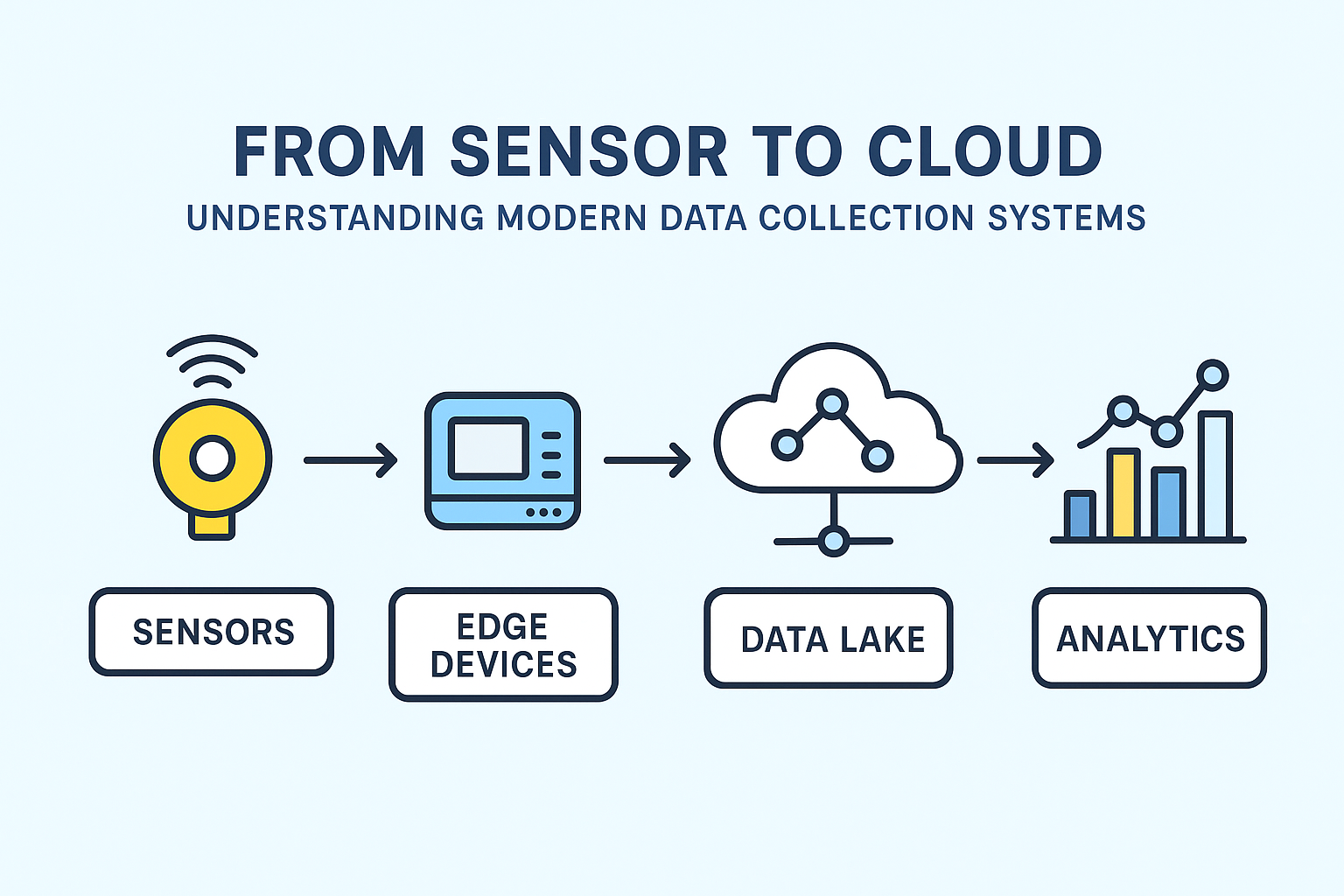
A data collection system is the complete pipeline that transforms real-world measurements into usable digital information. Although implementations differ, they all follow a similar flow.
It starts with sensors capturing physical phenomena such as temperature, pressure, vibration or location. Their raw readings are processed by edge devices—microcontrollers, gateways or small embedded computers—that clean, filter or analyse the data locally. The processed information is then transmitted using communication technologies like MQTT, HTTP, or industrial fieldbuses.
Once in the cloud, an ingestion layer validates and enriches the data before storing it. Increasingly, organisations retain both raw and processed data in a central Data Lake, allowing them to preserve information in its original form and reuse it in future applications.
Finally, analytics systems turn this stored data into insights. Dashboards show real-time behaviour, reports reveal trends, and machine learning pipelines uncover patterns that enable predictive maintenance, optimisation, and automation. Together, these stages form a single unified architecture where reliability at each step is essential.
Why “Structured” Data Isn’t Enough Anymore
Historically, systems stored only summaries: averages, alerts, thresholds. It worked when storage was costly and analysis was straightforward. But today organisations expect far more. They want long-term historical data, the ability to investigate past anomalies, and the capacity to train machine learning models that demand large volumes of detailed information.
The conclusion is simple: raw data is increasingly valuable, even if its purpose is not yet known. Modern systems therefore prioritise storing as much as possible, not just what seems important in the moment.
Data Lakes: The Natural Destination for Modern Data
This shift has made Data Lakes a key component in data collection architectures. A Data Lake stores raw, semi-structured and structured data without enforcing a schema, making it ideal for IoT scenarios where formats evolve over time.
Because storage is cheap and scalable, organisations can keep years of sensor data. This enables new analytics, supports machine learning, helps meet regulatory requirements, and allows old data to be reprocessed with new algorithms—often where the greatest long-term value emerges.
Where Data Collection Systems Are Used
Data collection systems appear in almost every sector:
Industrial automation: motors, pumps, compressors
Automotive & transport: vehicle telemetry, fleet monitoring
Energy: smart grids, metering, solar and wind assets
Buildings & cities: HVAC optimisation, occupancy and water systems
Healthcare: medical devices, wearables, patient monitoring
Consumer IoT: smart home devices and appliances
Anywhere a system needs awareness of its environment, a data collection pipeline is at work.
What’s Coming Next in the Series
The next articles will explore each layer of the pipeline in depth—from sensors and edge processing to connectivity, cloud ingestion, Data Lakes, and analytics.